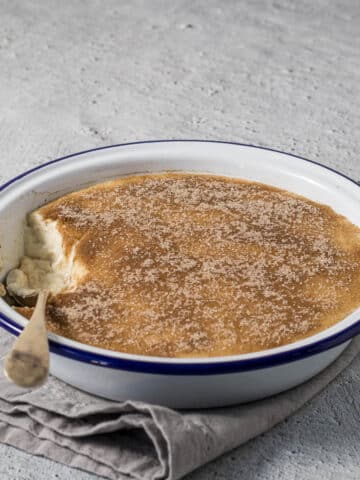
This easy, homemade malva pudding is flavored with apricot jam and drenched in a rich cream sauce. Serve it warm with custard, cream, or ice cream for a delicious comforting dessert.
You only need a few ingredients for this delicious old-fashioned Malva pudding/ Malvapoeding.
This pudding is more similar to an English-type pudding that is baked, steamed, or boiled, and quite unlike the custard-based American-style pudding.

Jump to:
About Malva Pudding
Malva pudding (or Malva poeding) is a quintessential sweet, comforting traditional South African dessert. Traditional malva pudding consists of a sponge layer that has been flavored with apricot jam (which can be found in probably every single South African kitchen or pantry), and leavened with baking soda (bicarbonate of soda/bread soda) and vinegar. While the sponge is baking, a sauce consisting of cream, butter, and sugar is heated and poured over the Malva cake as soon as it comes out of the oven. Similar to the South African Tipsy Tart or Cape Brandy Pudding.

Recipe Updates
I decided this recipe needed a few new photos and some video footage. But while I was putting this together I decided to experiment ever so slightly with the method, adding the melted butter, milk, and vinegar separately to the egg mixture and then adding in the dry ingredients. Mostly because I wanted to see if this made any difference in the final outcome, and it didn't. So while I haven't touched the original recipe in the recipe card.
I also baked this dish at 180°C instead of 200°C and honestly, the final outcome was no different.
Ingredients

Malva Pudding Sponge
- White/caster sugar/granulated sugar: this is key to the flavor profile of the Malva pudding sponge which needs to be delicate and flavored with the apricot jam. Because the sugar is beaten into the eggs, it acts as a leavening agent in the sponge as well.
- Apricot jam: traditional flavor profile for the Malva sponge, however, if you need a substitute for the apricot jam - I have used honey, golden syrup, or maple syrup in a jam (pun intended) with great results.
- Eggs: the two eggs in this recipe, play an important role in the leavening of the cake as the eggs and sugar are beaten together. I use New Zealand size 6 eggs which are around the same size as Australian and South African Large Eggs, but closer to a US/Europe Medium sized egg.
- Butter: this recipe calls for butter, but if you only have margarine on hand, it will work just fine.
- Milk: regular whole milk is called for in this recipe. And is made acidic with the addition of vinegar.
- Vinegar - you can use malt vinegar, white vinegar, white wine vinegar, or apple cider vinegar. The vinegar reacts with the baking soda in the batter, allowing the batter to rise during the baking. It also adds to the flavor profile. The use of vinegar will result in the curdling of the milk. But adds to the flavor profile.
- Baking soda: the preferred leavening agent because of the addition of vinegar and apricot jam. If you do not have baking soda, replace it with 3 teaspoons of baking powder and leave out the vinegar completely.
- Plain flour (all-purpose flour/standard grade flour) refers to flour that has a protein content of approximately 9.5-12%.
Pudding Sauce
- Evaporated milk (Ideal Milk) lends the sauce a slight caramel flavor that is enhanced with the addition of brown sugar. However, you can substitute the evaporated milk with cream, or half-cream and half-milk. Evaporated milk is sometimes known as unsweetened condensed milk. It is basically a shelf-stable milk in which 60% of the water has been removed.
- Brown sugar gives the sauce a delicious caramel flavor.
- Butter adds a richness that just can’t be matched with margarine. But if you have to, it’s okay, I won’t tell anyone.
- Water helps thin out the sauce so that it can reach every nook and cranny of the sponge. If you are feeling a little naughty, you can replace the water or a portion of the water with either brandy or sherry.

Weighing and Measuring Ingredients
Weighing ingredients with a kitchen scale is more accurate than using measuring cups. All my recipes are developed and tested using grams only.
However, I have activated the metric-to-cup conversions. Simply click on "USA/Cups" or "metric" for your preferred measurements. For these conversions, cups are equal to 240mL/8 fl oz, tablespoons are 15mL and teaspoons are 5mL.
Small-Batch Malva Pudding
This Malva pudding can easily be halved by clicking on the "½: button above the ingredients, and baked in a smaller casserole/baking dish (that has a 1.2-1.5L volume). If I was halving the recipe, I would probably make the sauce with cream so as to not have half a tin of evaporated milk bouncing around the fridge.
Step-By-Step Instructions
1 - Preheat the oven to 180°C/355°F. Grease a large glass or ceramic ovenproof dish (I used a 9 Inch or 23cm square baking dish).
2 - Place the sugar, eggs, and apricot jam in a large mixing bowl or the bowl of a stand mixer, and beat (with a whisk attachment) until the mixture is light and fluffy (this takes about 3-5 minutes). This can be done by hand.

3 - Sieve the flour, baking soda, and salt into the egg mixture. Mix until just combined. The batter with be thick.
4 - Either in a small saucepan, or a microwave-proof bowl or jug, heat together the milk, butter, and vinegar, mixing until combined. The mixture will curdle. This is fine.
5 - Add the butter mixture to the batter and whisk until a smooth batter forms. Scrape down the sides of the bowl and make sure everything is well combined.
6 - Pour the malva pudding batter into the glass or ceramic dish, and smooth to the edges. Cover the dish with an ovenproof lid or with tin/aluminum foil. Bake in a preheated oven for 20 minutes. Then remove the lid or foil cover, and bake for a further 15-20 minutes or until the malva cake is a deep golden brown and a cake tester/toothpick comes out mostly clean from the center of the pudding.

7 - During the last 10 minutes of the sponge baking, combine all sauce ingredients in a saucepan. Stir the ingredients together on medium-high heat until the butter is completely melted, the sugar is dissolved, and the sweet sauce is heated all the way through.
8 - Once the sponge is baked, remove it from the oven. Prick all over the pudding with a cake tester, skewer, or toothpick. Pour the sauce over the top of the pudding. At first, it will look as if there is too much sauce, but it will be rapidly absorbed into the sponge.
9 - Serve the warm pudding with some fresh cream, custard, or a scoop of ice cream.
Expert Tips for This Recipe
- I highly recommend baking this pudding in a ceramic or glass dish. Simply because it has a long baking time and is meant to be served warm.
- Cover the Malva pudding in the first half of the bake, this really allows the sponge to rise without the top browning to quickly, making it super soft! If your dish doesn't come with a lid, simply tent some foil over the dish.
- If using a fan-assisted, convection, or air-fryer, reduce the temperature by 20°C/25°F
- Make sure your oven is properly preheated when baking.
- Remember that all ovens work slightly differently and bake times may need to be adjusted for your specific oven.
- I recommend using an oven thermometer for increased accuracy.
- For an old-fashioned Malva aesthetic, bake this dish in and old school ceramic dish.
Storage and Freezing
Store this pudding covered in the fridge for 4 to 5 days. I recommend reheating the pudding in the microwave before serving.
This pudding can be frozen for up to 2 months. Make sure the pudding is sealed in an airtight container. Allow it to defrost in the fridge overnight before serving. Heat in the oven or the microwave before serving.
Malva Pudding FAQ
Yes. Evaporated milk (or Ideal milk) can be used to make the Malva Pudding sauce instead of cream.
Yes. I have substituted the apricot jam with honey, golden syrup or maple syrup in a pinch.
Yes. The pudding sauce can be made with evaporated milk instead of cream
Yes. Malva Pudding is usually made with bicarb and vinegar, however, baking soda in this recipe can be replaced with 3 teaspoons of baking powder and the removal of vinegar in the recipe.